Your Best Work Leaves No Trace: Why Engineering Teams Reward the Fix and Replace the Prevention
From testing and reliability engineering to team culture, the hardest problems are prevented, not fixed. Yet we chronically undervalue prevention, and let visible process stand in for the invisible outcomes that actually matter.
A production incident gets fixed under pressure late on a Friday, and by Monday the engineer who saved the day is the center of attention. Earlier that same quarter, a different engineer quietly did the work that kept a separate system stable: writing a test covering a rare edge case, fixing a backup routine, or tightening permissions before anyone could exploit them. None of that work earns a mention, because the outage it prevented never happened.
We celebrate the fix and barely perceive the prevention. That should bother us, because prevention is not heroics. It is simply the job done properly. The trouble is that doing the work well produces a set of absences: the outage that did not happen, the data that was not lost, and the breach that never occurred.
Absences make terrible portfolio pieces. You cannot easily point to a catastrophe that never came to pass, and you cannot provide visual proof of a smooth, quiet Friday night.
This asymmetry quietly shapes how engineering teams spend their attention. It is a dynamic that deeply resonates with my own experience, and even organizations that actively strive for balance struggle against the gravity of the visible crisis. The pressure is structural rather than personal. It explains a surprising amount: why testing, security, and backups perennially lose the prioritization fight, and why the most common organizational response backfires. Faced with prevention we cannot see, organizations reach for a visible proxy for it, and that proxy quietly crowds out the prevention it was meant to protect.

An Old, Uncomfortable Asymmetry
The core observation here is neither mine nor is it new. It is one of the most rediscovered ideas in all of applied reasoning.
Back in 1850, Frédéric Bastiat told a simple story, now known as the parable of the broken window, about a boy who breaks a shop window
A century and a half later, Nassim Taleb gave the same idea its sharpest modern form, calling it the problem of silent evidence. He imagines a legislator who, at great political cost, forces every airline to install locked, reinforced cockpit doors, with the law taking effect on September 10, 2001
The management literature has a name for the organizational version of this. Repenning and Sterman called their study of it, perfectly, “Nobody Ever Gets Credit for Fixing Problems that Never Happened”
So the diagnosis is settled and ancient. What I find more interesting, and less discussed, is what organizations actually do in response to this asymmetry. Because they do not simply underfund prevention and leave it there. They reach for something that looks like prevention and is much easier to see.
Prevention Theater
When real prevention earns no credit because it produces no signal, organizations look for a substitute. So we substitute a version of prevention that does produce a signal: a gate, a checklist, a mandatory sign-off, a ceremony, a required reviewer, a manual QA pass on every change. These things generate artifacts. They populate a dashboard. They give a manager something to point at when someone asks what we are doing about quality. I’ll call this prevention theater, with a deliberate nod to Bruce Schneier’s “security theater,” the airport-style measures that make us feel safer without making us safer
The trouble is not that gates are useless. A good gate verifies quality that is already there, and the best processes go further and build it in: a pilot’s pre-flight checklist or a surgeon’s pre-incision checklist makes the right step happen rather than merely recording that someone looked. Those earn their place, and the discipline is to keep asking which ones still do. The trouble is the other kind, the process bolted on to fight symptoms, standing in for quality the work does not have.
Quality control has known this for a long time. W. Edwards Deming, quoting Harold Dodge, put it in one line: “You cannot inspect quality into a product.”
I’ve argued before that scrappiness tends to launder unmanaged debt into a virtue (see Scrappiness Incentivizes Sloppiness), and that the speed-versus-quality trade-off is mostly a myth once you look at the data. Prevention theater is the mirror-image failure. Scrappiness skips the invisible work and admits it. Theater skips the invisible work while producing a convincing artifact that says otherwise, which is more dangerous, because it buys a false sense of safety. An ignored test suite, a rubber-stamped review, or a massive code diff nobody actually reads: each is a green light wired to nothing.
The tell, every time, is that the artifact has become the goal. This is Goodhart’s law in miniature: when a measure becomes a target, it stops being a good measure, because a proxy is always easier to optimize than the messy reality it stood for
The Same Trap, With People
This identical pattern runs through the human side of engineering, yet the technical and organizational versions of this failure are rarely treated as one.
A team’s real standard is not what it writes in a values doc. It is the worst work it tolerates without comment. Lieutenant General David Morrison put it memorably (crediting the line to David Hurley): “the standard you walk past is the standard you accept.”
The asymmetry repeats perfectly. The act that actually holds a standard is direct engagement with sub-par work. It requires pausing, having a slightly uncomfortable conversation, asking for rework, and coaching toward the bar. Because its entire payoff is an absence (the erosion of quality that did not set in), this work is quietly skipped, because shipping anyway always feels easier in the moment. And what do organizations reach for instead? A visible proxy. More process. A PR template, a mandatory second reviewer, a sign-off step, a heavier definition of done. This is the same prevention theater in a different costume: an artifact that says “we have standards” standing in for the invisible work of actually holding them.
The conversation is the prevention. The process is theater whenever it stands in for that conversation instead of provoking it. One produces a record; the other produces a culture, and only one of them is easy to point at in a performance review.
The Same Failure, Different Clothes
Once you line the two up, the engineering version and the human version, it is hard to see them as separate problems. They are the same failure wearing different clothes.
In both cases, risk accumulates silently, with no signal, until it doesn’t. James Reason called these latent conditions: weaknesses that sit dormant in a system, contributing nothing visible, until they line up with a triggering event
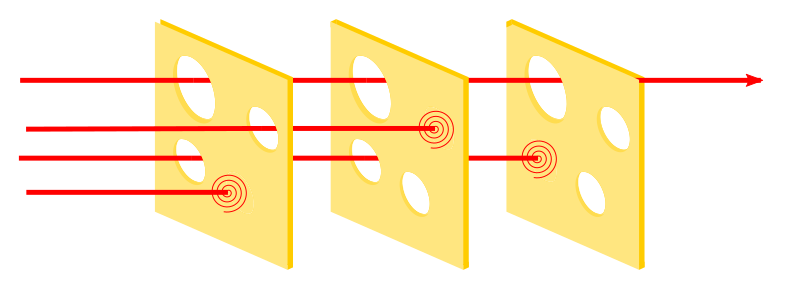
And one decision plays out the same way in code and in people. The instinct that underfunds the test suite is the instinct that skips the standards conversation. The reflex that adds a QA gate is the reflex that adds a review template. It is not stupidity or laziness. It is a rational response to an incentive landscape where the visible is rewarded and the invisible is ignored.
That landscape is built by the same cognition working in everyone, the manager included. Two biases, both long documented in psychology, keep prevention from ever registering as something worth rewarding. The first is the availability heuristic: we judge what matters by what comes to mind
Therefore, the fix is not to simply try harder to value invisible work. Willpower loses to incentives every time. This is Reason’s point exactly: we cannot change the human condition, but we can change the conditions under which people work
Why the Trap Pays
That fix is clear enough on paper, which raises the puzzle the literature tends to leave hanging: if the trap is this old, this documented, and this costly, why are so many companies that fall into it successful anyway? Because it is an equilibrium, not a mistake. Theater becomes the dominant organizational strategy because its cost is paid now and is entirely certain. Conversely, the payoff of real prevention is deferred and structurally unprovable. The engineer who prevents an outage holds only a counterfactual, with no proof that a disaster would have occurred or that they were the one who stopped it. The engineer who fixes an active outage holds concrete evidence: system logs, timestamps, incident reports, and a grateful customer. Even a firm that genuinely wants to reward prevention cannot easily price what its own people cannot prove, making the visible proxy the rational purchase.
But the asymmetry runs deeper than proof. The engineer spent months working through the disaster scenarios their work ruled out and can still picture each one; everyone else cannot even imagine what might have gone wrong. This is the simulation heuristic, availability’s counterfactual cousin: we weigh a danger by how easily we can imagine it, so the averted one barely registers for anyone but them
And no single firm is uniquely punished for choosing the proxy, because its competitors all make the same move. You are graded against rivals who are equally afflicted rather than against perfection. This is the unobservable-quality problem that George Akerlof named in the market for lemons, applied one level up
And the bill, when it comes due, hides on the same axis as the prevention. Latent conditions accumulate for years with no feedback, so a company can run on borrowed reliability and tolerated lapses long enough to get acquired, pivot, or ride a market wave before the holes line up. The successful-yet-afflicted firms we point to are partly just the ones where the cheese has not aligned yet; the ones it sank are the silent evidence we never see
But survivorship is only half of why the giants get away with it. The other half is that revenue is not a referendum on prevention. The largest firms win on entrenched advantages, on network effects, distribution, and sheer scale, and the profit those throw off is wide enough to absorb mediocre engineering as drag rather than death. Insulated from fierce competitive pressure, a massive firm simply carries the organizational slack. Economists refer to this as X-inefficiency, a phenomenon routinely found in companies that do not operate under strict survival pressures
And even when it never blows up, the trap is not free. Firefighting is its own standing tax: a reactive, draining mode of work that quietly costs the engineers who stop trusting their own systems and take their ambition elsewhere.
Telling the Proxy From the Thing
Changing what the work produces has a catch: any signal you invent to make prevention visible is one short step from hardening into the next gate. So the whole game is one question you can apply anywhere:
Does this measure the absence I actually care about, or does it just produce evidence that I did something? The first is prevention. The second is theater.
The cleanest thing I know that passes is the SRE practice of error budgets and service level objectives
The same test sorts real review from theater. A reviewer who only records that someone looked fails it; review that genuinely engages with the work passes. But review is not where quality comes from. Only the author can build quality in, because only the author shapes the work, so responsibility for the result stays with them whoever signs off. Good review does not relieve them of that; it is two people raising the bar together, iterating toward something better than either would ship alone. The alternative to a rubber stamp, then, is not a lower engineering bar but authors who own what they merge and reviewers who genuinely sharpen it. A gate absorbs that ownership; a real metric, and a real review, hand it back.
The test carries straight to the human layer, where it says protect the conversation, not the template. Engaging with sub-bar work, directly and early, is the high-leverage act, but it only has weight if the bar is real, which means the people who hold it have to visibly live it. A team whose leaders preach quality and ship slop on a deadline learns, accurately, that quality is a slogan. Keep consequences in reserve, too, as the rare backstop that keeps everyday coaching credible. The template proves a step happened; the conversation changes the work.
Because real prevention creates no incident logs on its own, you must build that narrative deliberately. When an automated test catches a critical regression before it ships, or when a difficult conversation pulls a design back up to the bar, name that outcome out loud. This is the only way invisible work wins the narrative credit that visible crises receive for free.
Crediting What Never Happened
The asymmetry that opened this essay is old, and it is not going away. We are wired to commit the classic economic fallacy Frédéric Bastiat identified: focusing on the broken window while staying blind to the unseen value lost to pay for it
We cannot undo those cognitive biases. But we usually pile a second, preventable mistake on top of it. Because we cannot see real prevention, we reach for an artifact we can observe: a gate, a checklist, a heavier process, a formal record. Anything that lets us feel covered. That substitute is never free. It crowds out real prevention, and the safety it promises is mostly an illusion.
Therefore, the discipline required of modern engineering organizations is threefold:
- Normalize counterfactual credit: Celebrate and protect the problems that never happened loudly enough that the people who prevent disasters can survive a performance review.
- Audit your metrics: Where you do build a tracking signal, keep it strictly tied to the operational outcome you care about, and constantly verify that it has not decayed into an empty checkbox.
- Distrust structural shortcuts: Reject anything that promises to make prevention cheap or mechanical. The durable asset was never the formal process, but the underlying engineering culture that builds quality in before any gate runs.
For my part, I believe prevention is an investment and the fix an expense.
If you are the engineer doing this quiet work, do not draw the cynical conclusion that prevention is a dead end, that you should let things break to be seen fixing them. The reward exists; it just sits on a slower ledger. Heroics earn applause, but prevention earns trust: the autonomy and hard problems that compound into the engineer everyone wants on their team. And everyone ends up firefighting sometimes, because no sane system runs at zero risk. What separates the best is not how often they are the center of attention, but how rarely their own work puts them there.
The mistake is not doing the invisible work; the mistake is doing it silently. Make the counterfactual legible: name the catch, and say what those quiet days bought the business, concretely enough that hindsight cannot wave it away. This is the signal that answers Akerlof’s lemons problem from earlier, making quality visible when it would otherwise go unpriced
The moment you have any leverage over what an organization rewards, use it.
What is easy to measure is almost always the theater.
What matters is almost always the problem you never had.
Enjoy Reading This Article?
Here are some more articles you might like to read next:
- Why your next visual quality inspection system will be training-free
- Industrial anomaly detection: Using only defect-free images to train your inspection model
- Opinion: What the Hugging Face Incident Changed in How I See the Current State of AI
- A Good Predictor Is Not Yet a Good Forecaster: Why Forecasting Needs Knowledge Beyond the Data
- Same Evidence, Opposite Certainty: Why AI Timelines Polarize on Shared Evidence
- Trust Is a Posterior: Why Good Work Can Only Be Appreciated Statistically
- Ship the Upgrade Path First: Distribution as a Control Plane for Fast Iteration
- The Two Cuts of an MVP – Why Iterating and Incrementing Both Come Down to Vision
- Would AI Invent the Clock?
- The Self Before Memory: Why the AI You Talk to Is Partly Your Creation
Subscribe to be notified of future articles: